The Immortal Botanica Soojin Jeong
We are delighted to feature Soojin Jeong’s electroformed pieces of nature in her show,The Immortal Botanica. Whether it is an insect or plant, Soojin’s process captures the beauty of the end of a life cycle.
Artist Statement
My work begins where life appears to end.
Guided by the principle of non-harming, I never take from what is still alive. Instead, I gather only what nature has already relinquished—fallen petals, dried seed pods, insect exoskeletons, abandoned wings, and other fragile remnants. What many regard as debris, I recognize as the final gestures of life.
Over the years, I have come to think of myself as a mortician for nature.
Like a mortician preparing a body with dignity before its final farewell, I carefully preserve these remains through electroforming and casting. My process becomes a quiet funeral rite—not an act of mourning alone, but one of reverence. Metal does not erase death; it carries its memory. Each piece becomes a tribute to impermanence, allowing what nature has surrendered to continue its existence in another form.
In nature, death is never an ending. It is a threshold through which one form quietly becomes another. A withered petal, an empty seed pod, and the shell of an insect all bear witness to this continual transformation. By preserving these fragile forms in metal, I seek not to deny decay, but to reveal the quiet beauty that exists within it.
Underlying this practice is the ancient Buddhist vision of Indra’s Net—a universe in which every being reflects every other being and nothing exists independently. I see every petal, seed, and fragment of nature as a mirror of the whole: a small universe containing infinite relationships. Metal becomes more than a material; it becomes a visible vessel carrying an invisible pulse of life, giving tangible form to the unseen web that connects all living things.
These works are therefore not merely jewelry. They become vessels of remembrance, talismans of protection, and sacred echoes of lives that have quietly passed. They invite the wearer to carry not simply an object, but a meditation on existence itself.
Many of my seed pods remind me of women’s lives—the quiet strength to carry, release, nurture, and begin again. Their cycles echo the rhythms of nature: birth, flourishing, decline, resilience, and renewal. In these fragile forms, I find reflections of our own humanity.
A single seed, no larger than a speck of dust, holds an entire universe within it. Hidden inside is the astonishing potential to become roots, leaves, flowers, fruit, and countless seeds yet to come. Yet not every seed survives. Some are carried away by the wind. Others are damaged before they ever have the chance to grow. But when a seed finds the right soil, moisture, and light, it unfolds into a life far greater than itself.
Working with botanical forms has continually led me to reflect on the human condition. Like seeds, our lives are shaped by chance, circumstance, and time. All living things have a beginning and an end. Most of us do not live with death constantly in mind. Yet in my garden, I witness the cycles of life and death every year. There, I am reminded that life is deeply meaningful precisely because it is so fleeting.
Ultimately, my practice is an act of reverence toward impermanence. By preserving what is fleeting, I seek to reveal that beauty is not found in resisting change, but in embracing it. Every piece becomes a quiet threshold where life and death, nature and humanity, memory and renewal meet—where the finite opens quietly into the infinite.
Join us at the opening!
Friday, July 10th, from 5 pm to 7 pm
This exhibition will be on view from Friday, July 10th to Friday, August 28th, 2026
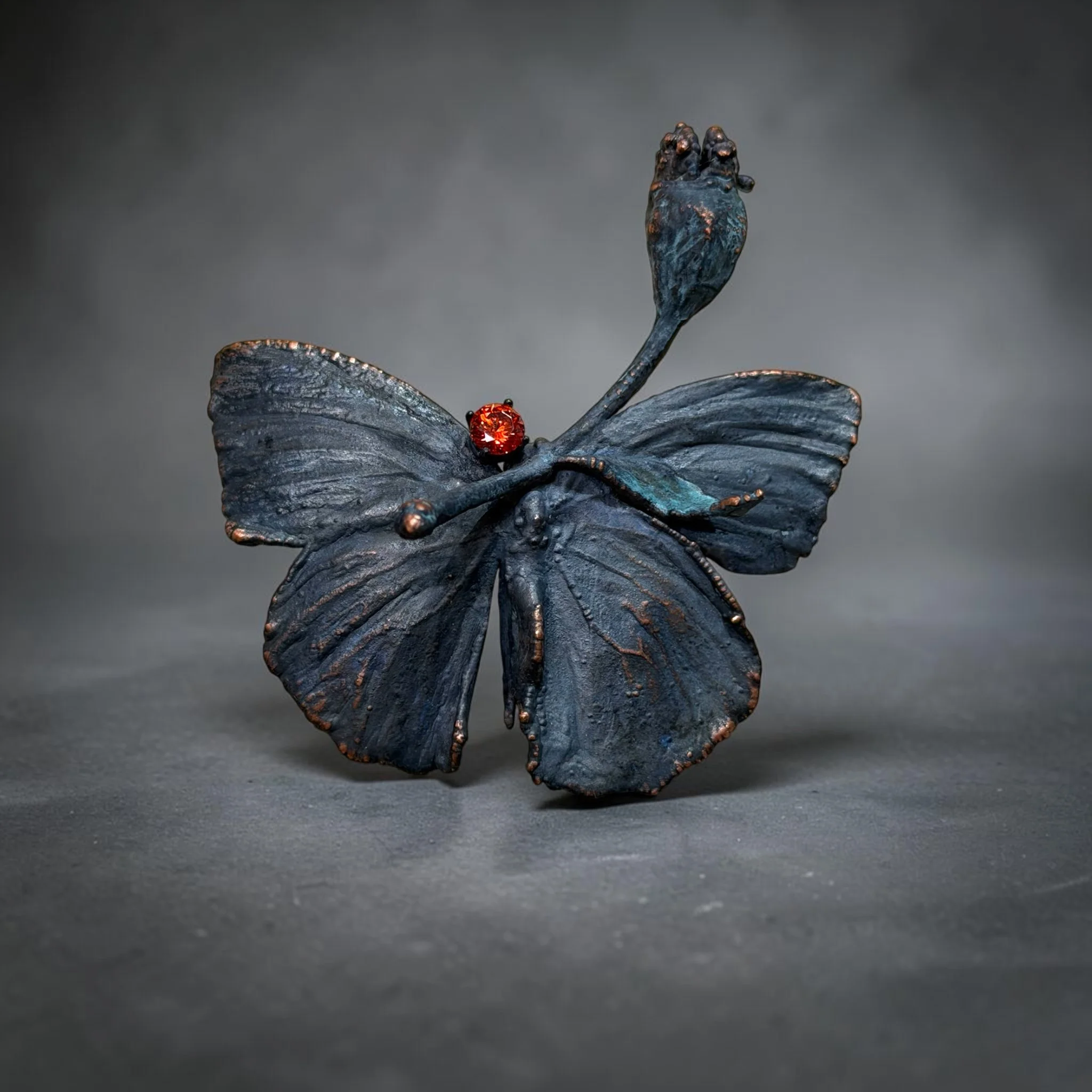
Moth and seed pod.
Electroformed copper and orange cubic zirconia
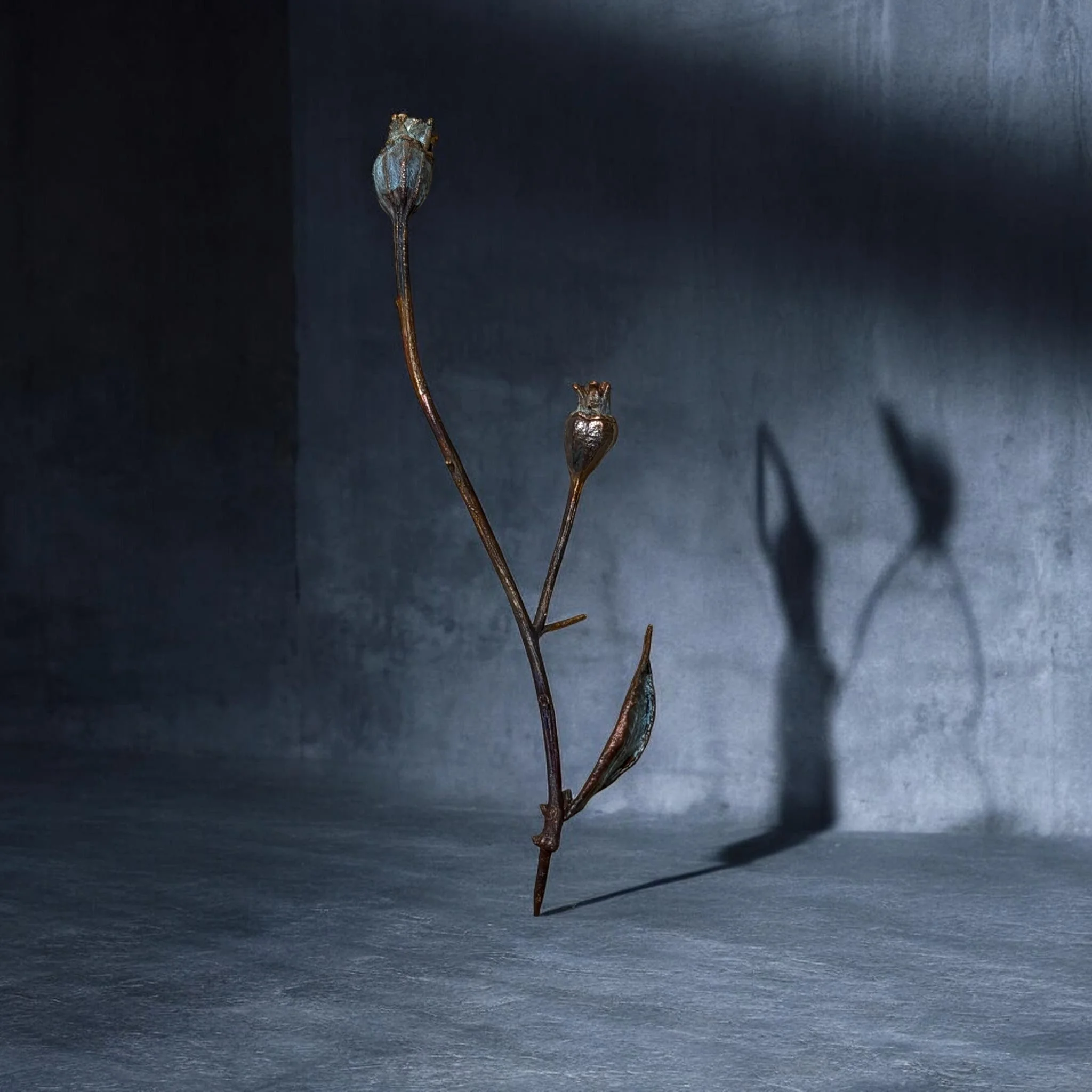
Seed pods
Electroformed copper and cubic zirconia